

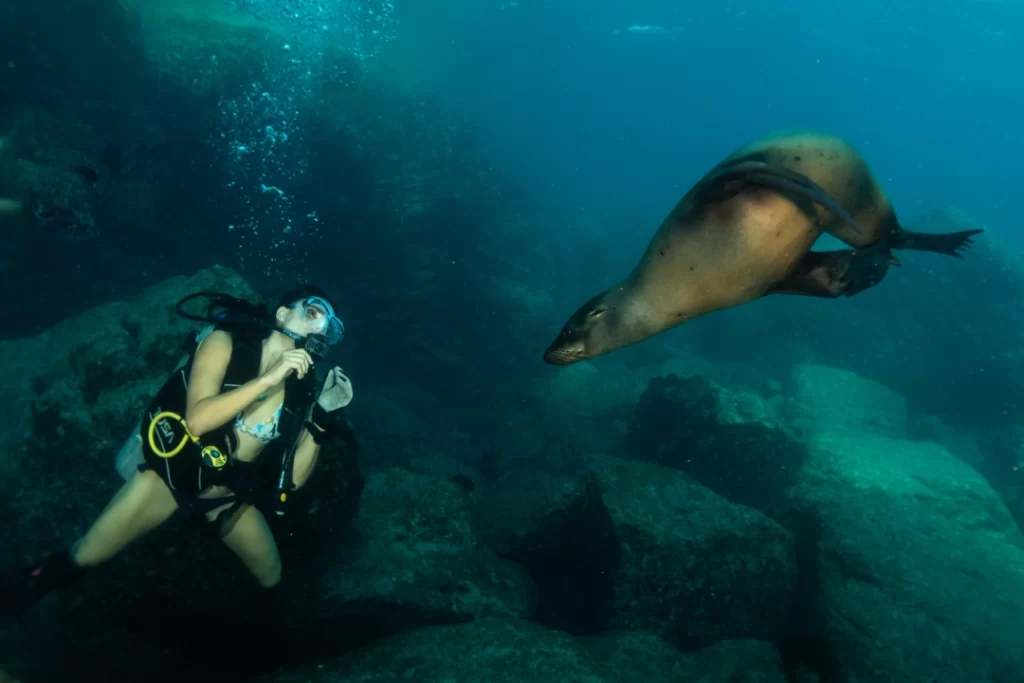
Get certified and dive whenever you want!
Are you ready to discover a whole new world?
PADI Open Water Diver is the first scuba certification level. A highly-trained PADI Instructor will teach you how to scuba dive in a relaxed, supportive learning environment.
Unlike a one-day introductory dive, the PADI Open Water Diver course in La Paz, is a comprehensive three-day certification that transforms you from a novice into an autonomous, globally certified diver. This program grants you the foundational skills and independence to dive anywhere in the world up to 18 meters (60 feet).
Oceanographic Guide and Marine Conditions of La Paz (Training Focus)
The Sea of Cortez provides a dynamic, real-world training environment to forge competent autonomous divers.
Visibility: La Paz waters offer an excellent operational training visibility of 15 to 25 meters, frequently peaking at 30 meters during optimal conditions, allowing for clear visual communication with instructors.
Seasonal Temperatures and Thermal Protection
Proper thermal management is a core competency. Seasonal variations range from winter lows of 19-22°C (requiring 5mm suits with hoods) to warm summer highs of 25-30°C (3mm suits), ensuring you learn how to adjust buoyancy based on different neoprene thicknesses.
| Season | Period | Water Temp | Suggested Exposure Suit |
| Winter | December – February | 19–22 °C (66–72 °F) | Full 5mm wetsuit |
| Spring | March – May | 20–24 °C (68–75 °F) | 3mm to 5mm wetsuit |
| Summer | June – September | 25–30 °C (77–86 °F) | 3mm wetsuit or shorty |
| Autumn / Fall | October – November | 24–29 °C (75–84 °F) | 3mm wetsuit or rashguard |
Current Dynamics (Certification Sites): Your training follows a deliberate environmental progression. You will begin in the shallow, current-free waters of San Rafaelito to master core skills in a controlled setting. As your proficiency grows, your final certification dives take place at more technically demanding sites like Swanne Reef and the historic wreck of El Salvatierra (sunk in 1976). These advanced sites expose you to mild-to-moderate tidal currents, teaching you crucial real-world buoyancy control and current navigation.
Description
As an Open Water Diver student, you are no longer just a passenger; you are the pilot. You will learn to independently assemble, test, and manage your scuba unit as a fully integrated life-support system.
The Autonomous Equipment System: You will master the mechanics of the high-pressure cylinder and the dual-stage regulator (which steps down tank pressure and delivers air on demand via the primary and alternate air sources). You will learn precise inflation and deflation of the Buoyancy Control Device (BCD) coupled with a calibrated weight system to achieve perfect neutral buoyancy. Crucially, you will learn gas management using the Submersible Pressure Gauge (SPG), alongside maintaining your hydrodynamic fins and mask for optimal underwater efficiency.

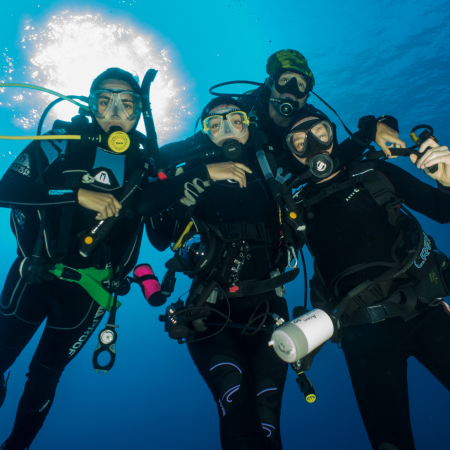
Itinerary
Certification Itinerary and Methodology (The Path to 18 Meters): The transformation into an autonomous diver takes place over three rigorous, highly structured phases:
Phase 3: Open Water Dives (Days 2 & 3): You will execute 4 real open water dives in the ocean. Depth and task complexity increase progressively, culminating at the absolute global certification limit of 18 meters (or 12 meters for Junior Open Water divers aged 10-11).
Phase 1: Knowledge Development (eLearning): Master the physics and physiology of diving, dive planning, and safety protocols online at your own pace before arriving in La Paz.
Phase 2: Confined Water Dives (Day 1 – Pool/Beach <2m): In a shallow, highly controlled environment, you will build muscle memory for five critical survival skills: mask clearing, regulator recovery, hovering/neutral buoyancy, proper air management, and panic control/emergency procedures.
Duration: 3 days.
Requisites: Must be at least 12 years old. No need for previous experience dcuba diving, but must be in good physical condition.
Difficulty: easy.
Open Water Diver: Training Sites Map (La Paz)
Interactive guide to confined water areas, shallow reefs, and advanced 18m certification dives in La Paz Bay.
El Salvatierra Wreck
An advanced open water training site. This 1976 shipwreck rests within the 18-meter depth limit for Open Water Divers, hosting large groupers, green moray eels, and sea turtles.
San Rafaelito Islet
A tranquil rocky islet with a resident California sea lion colony. With gentle currents and depths up to 10 meters, it’s the perfect site for your first two open water skill evaluation dives.
Swanne Reef
A shallow rocky reef located in the San Lorenzo Channel. You will practice buoyancy control while observing Cortez angelfish and damselfish navigating mild tidal currents.
Fang Ming Wreck
A relatively protected site with gentle currents. This wreck offers a calm dive around the structure, perfect for observing sea turtles and reef fish.
Los Islotes
Home to a significant colony of California sea lions. Currents can vary, offering a dynamic environment for observing marine life and sea lion interactions.
C-59 Wreck
This artificial reef experiences mild to moderate currents depending on the tides. It’s a fascinating structure that requires good situational awareness.
Muelle Fiscal (Departure Point)
Official check-in at 09:00 AM on the La Paz waterfront malecón. Includes boarding our shaded panga boat and the daily dive theory safety briefing.
Included
Dive instructor.
Scuba equipment.
Water, lunch, and drinks.
2 days of open sea dives and 1 day of pool dives.
Not Included
Alcoholic drinks.
You must bring
Ecofriendly sunscreen.
Bathing suit, comfortable shoes and a windbreaker.
Biodiversity Technical Sheets (Open Water Dive Sites)
Achieving your certification at sites like El Salvatierra and Swanne Reef rewards you with access to complex marine ecosystems. You will learn to identify:
Local Authority and the MTA Differentiator
Mexico Travel Adventure (MTA) delivers uncompromising educational standards. Our team consists of active-status PADI Instructors who are also credentialed marine biologists and naturalists.
Strict Safety and Evaluation Policy: To guarantee rigorous evaluation of PADI skills and personalized coaching, we enforce hyper-reduced group ratios of maximum 6 participants per vessel. This ensures zero overcrowding, meticulous attention to your technique, and an immersive, biologically informative training experience.
Frequently Asked Questions
What is the maximum depth for this certification?
18 meters (60 feet). For divers aged 10-11 years, the limit is restricted to 12 meters.
Can I dive alone after receiving my Open Water certification?
No, for safety reasons you can never dive alone. A certified buddy is required to assist in emergencies, such as sharing air, resolving a cramp, or calling for help at the surface.
What happens if my mask fills with water or fogs up?
During the course, we will teach you specific confined water techniques to easily clear your mask of water and clean it if it fogs up, allowing you to dive comfortably.